The phone desk built for selling life insurance. Every call, start to finish.
SwitchCX replaces the Amazon Connect agent workspace for licensed sales floors. It checks licence and consent before the greeting, listens while the customer talks, quotes carriers side by side mid-call, writes the wrap-up before they hang up, and grades every call against its script.


From the first line of code to the first live customer call on the production line.
Changes shipped to the live floor in seven weeks, each one through CI.
Automated tests over the rules that decide what an agent sees.
Call and failure states rehearsed in a simulator before an agent ever met them.
Built with a licensed life insurance agency running a 14-seat floor on Amazon Connect. Work began Sep 9, 2026.
The compliance answer is on screen before the greeting.
Two of the most common disposition codes in insurance dialers are "not licensed in the applicant's state" and "no valid consent on record". Agents hit both constantly, and find out after the call. SwitchCX checks five gates, in the order a life sale actually checks them, while the phone is still ringing.
Twelve states require all-party consent.The desk reads the state from the caller's area code and gates the script on the disclosure in each of them.
The licence gate knows the product.A variable product also needs a FINRA Series 6 or 7. The gate fails on the product, not only the state.
Hard stops are kept for hard rules.Licence, appointment and consent can block a sale. Replacement sits amber until the notice is recorded on the call.
It knows why they called before the agent types a word.
The wrap-up's reason for the call fills itself in from the customer's own words, using the CRM's own picklist. Four rules make it safe to fill a field nobody typed. This is the real rule set, replayed on a sample call.
Heard on the call: "We just had our second baby, and I want a quote on a million in term." Change it if that is not why they rang.
Sample call, written for this page. In production the transcript lives only in the browser's memory for the call and is never logged.
- Plays when an objection lands.The objection library is matched against what the customer said, alongside any Contact Lens category the flow raised. The rail suggests; it never interrupts.
- The read on the room, with its reason.Sentiment from the customer's latest lines, shown with the line that moved it, so the agent can act on it rather than interpret a number.
- Answer by lowering the boom arm.The desk talks to Jabra, Poly, EPOS and Yealink call controls straight from Chrome. The headset rings, and lowering the microphone picks up.
Every carrier, quoted and compared, on the call.
The illustration tab turns what the agent heard into a face amount, prices it across carriers, and keeps the guaranteed side in front of the projected one. Change the carrier and the compliance check runs again. Try it below.
Twenty-year level term, $1,000,000
Monthly · 8 of 8 carriersHow the number was built
DIME- Debt, excluding the mortgage
- $18,400
- Income replacement, 10 years
- $960,000
- Mortgage balance
- $284,000
- Education, two children
- $160,000
- Group cover in force Not portable
- ($192,000)
Sample applicant and sample rates, built from the desk's own illustration rules. The workspace ships today; live carrier rates arrive with the rater integration on the roadmap.
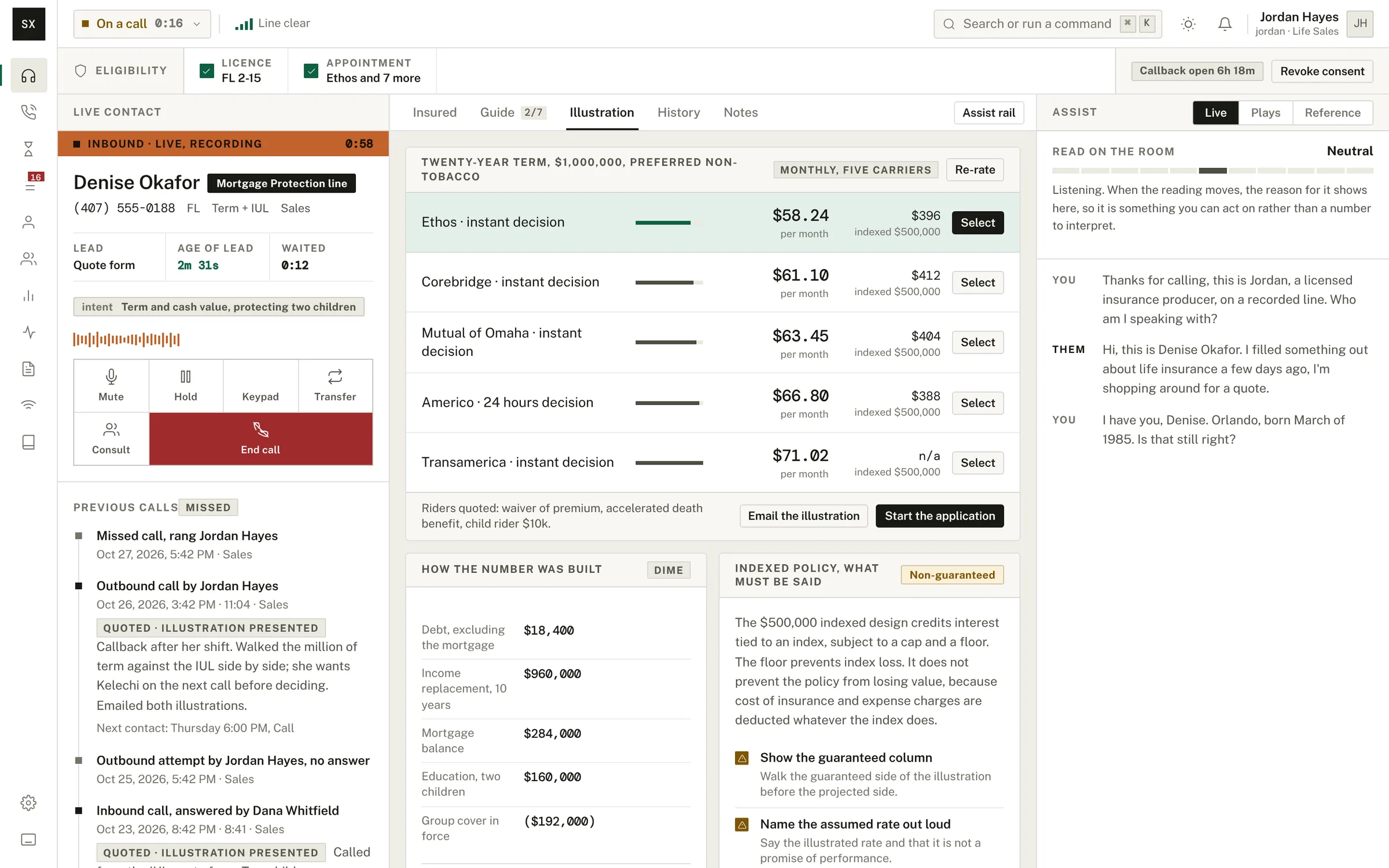
- The need, shown line by line.The agent walks the applicant through the arithmetic instead of asserting a number. Group cover is counted, and flagged because it does not leave the job with her.
- Guaranteed before projected.An indexed design always carries what must be said out loud: the guaranteed column first, the assumed rate named, and loans explained as loans.
- Quote, compliance and application are one screen.Pick a carrier the agent is not appointed with and the eligibility band turns red, before the application starts.

The wrap-up is written before they hang up.
After-call work is the largest recoverable cost on a sales floor. The sheet opens with the reason filled in, a summary drafted from the transcript, and an outcome suggested. The agent corrects what is wrong and closes.
- Saved to Connect and to Salesforce.Wrap-up codes land on the contact record for reporting, and as a Task on the matching Salesforce lead within seconds.
- One Task per call, even on a retry.Saves are idempotent on the call and the agent, so a dropped connection never files a duplicate.
- Sixteen outcome codes in the business's own words.Grouped as sold, with the carrier, still in play, not sold and could not sell, which is what Analytics counts.
Every answered call, graded against its script.
A minute after the call ends, Claude reads the transcript and checks each step of the script that call should have followed, in order, with the agent's own words as evidence. Managers stop sampling three calls a week and start reading the floor.
Every step that applied was done.
Nothing missed, some steps half done.
A step was skipped. It opens on the step.

A Shopper call, followed step by step, each step linked to where it was said. Held to the transcript in code. A quote that is not the agent's own words is thrown out, and names and numbers are replaced with [name] and [number] before anything is stored.
- Tuned against the managers, and measured.When a manager disagrees with a grade, the step's rule is sharpened in their words and a test call joins an evaluation set. Every deploy is graded against the whole set, so a fix never quietly breaks an earlier call.
The whole floor, this minute, from a phone.
A managers page that needs no phone sign-in and works on an iPhone. Who is waiting for a call and in what order, which calls are going badly right now, why people are calling, and what those calls turned into.
- A queue agents can trust.Ranked the way Amazon Connect will offer the next call. Stepped Away keeps an agent's place in line for up to five hours, which Connect on its own does not.
- Bad lines, caught during the call.Each desk grades its own audio, the agent's microphone and the customer's side separately, so a manager knows whose headset to swap before the complaint.
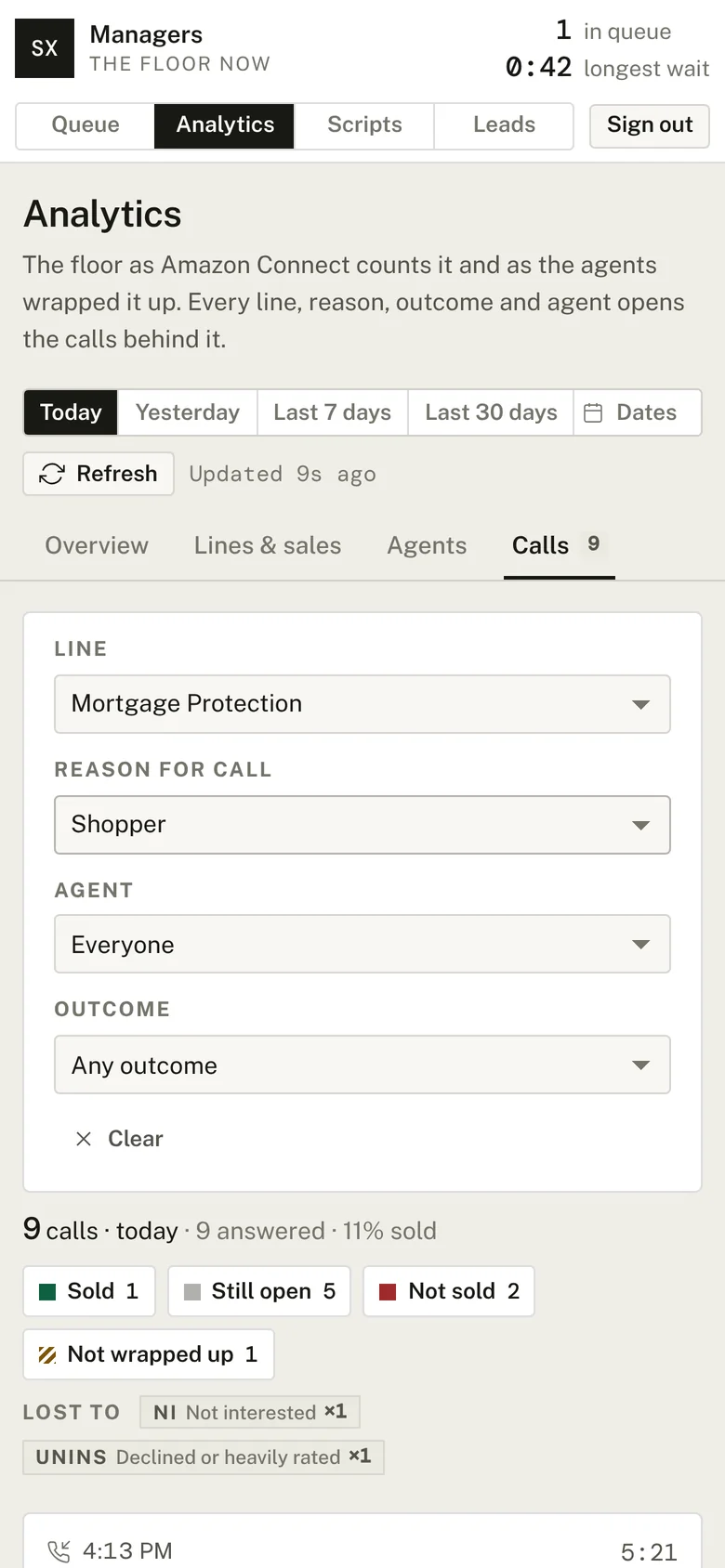
- From a count to the call behind it.Click a line's call count, then its sales, then the calls it lost, and read each one: the call's own summary with the agent's note beside it.
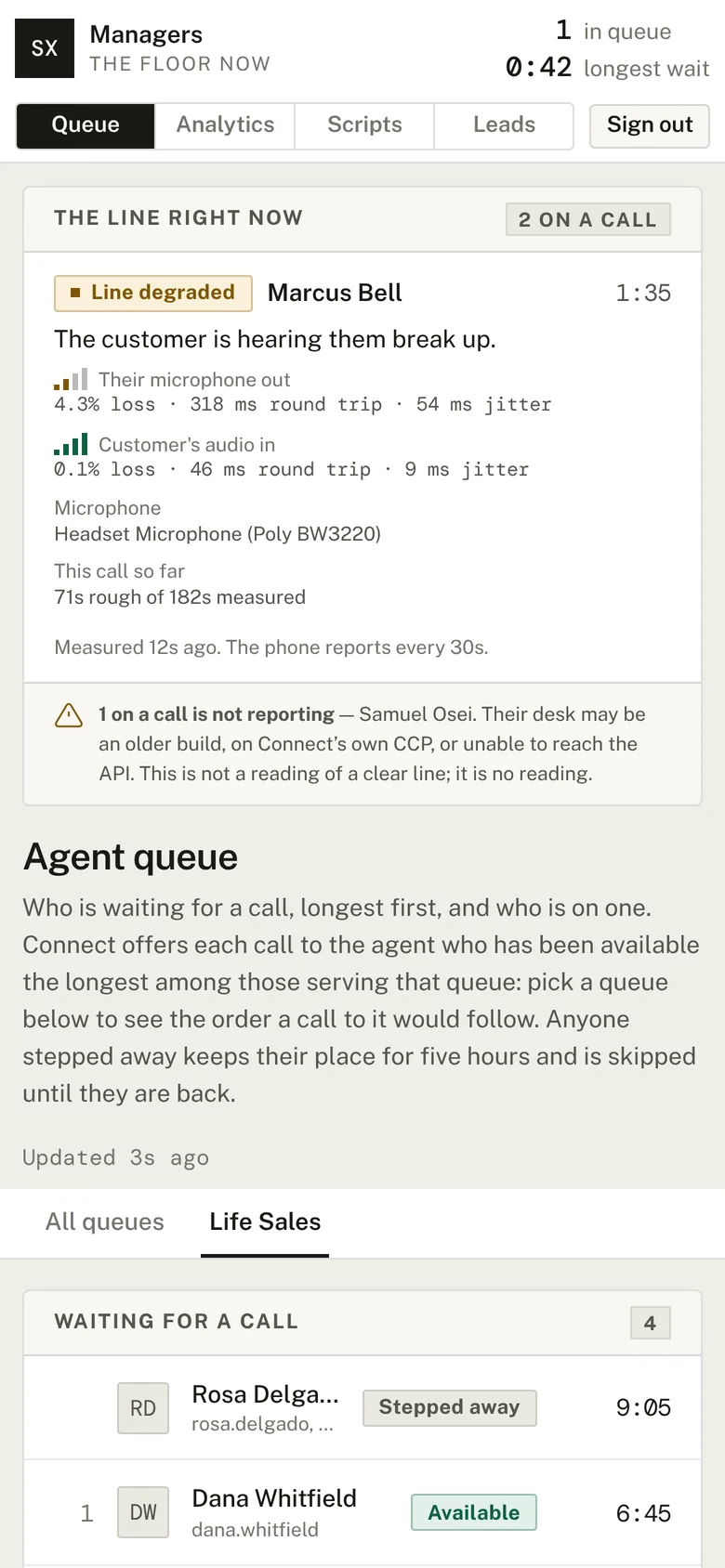
Who gets the next call
Waiting, on a call, and not taking calls, each with how long it has been that way, counting by the second. The agent's own row says "You are next" or "2 ahead of you".
Wait is measured from when an agent's last call cleared, which Connect's real-time data does not report.
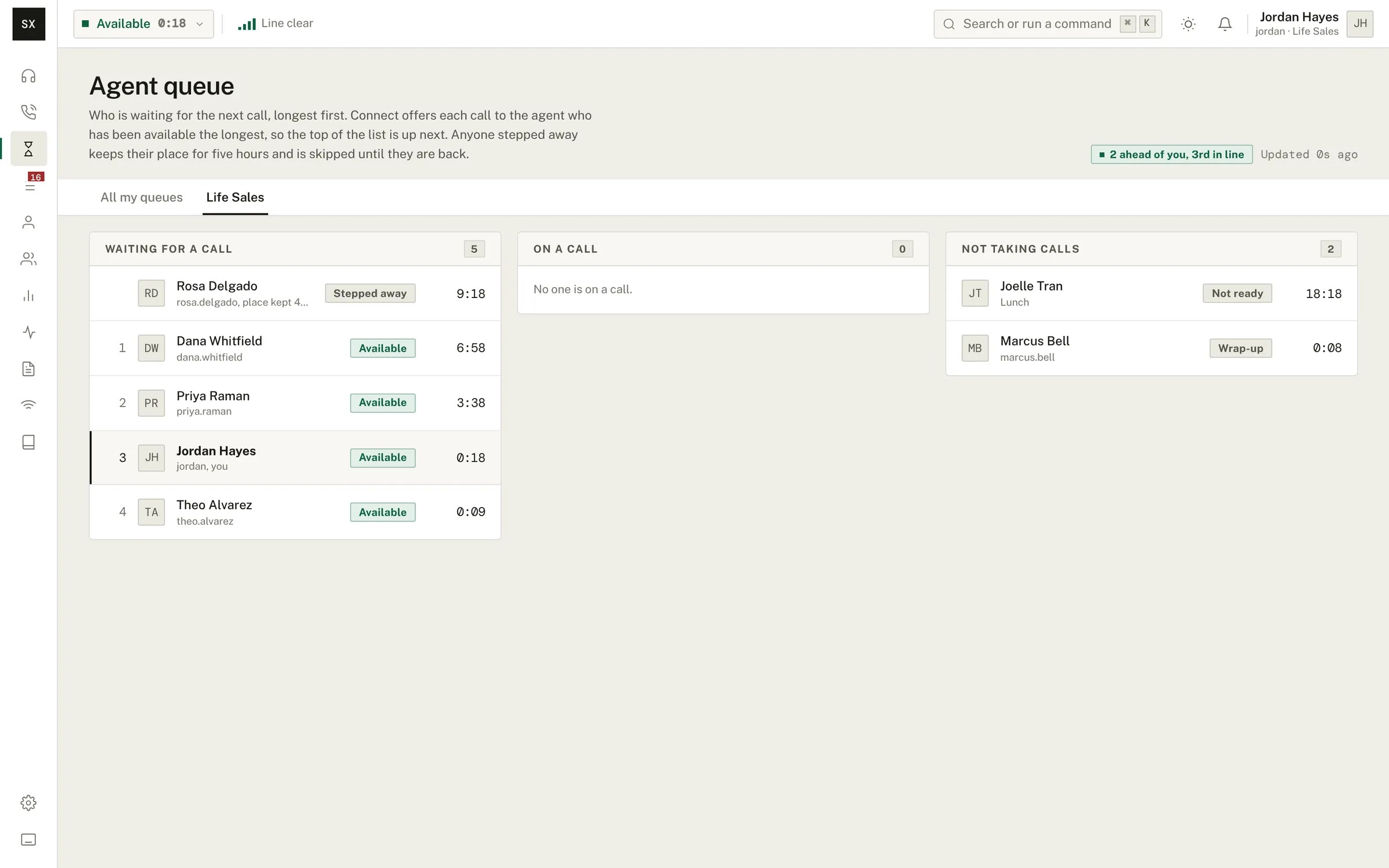
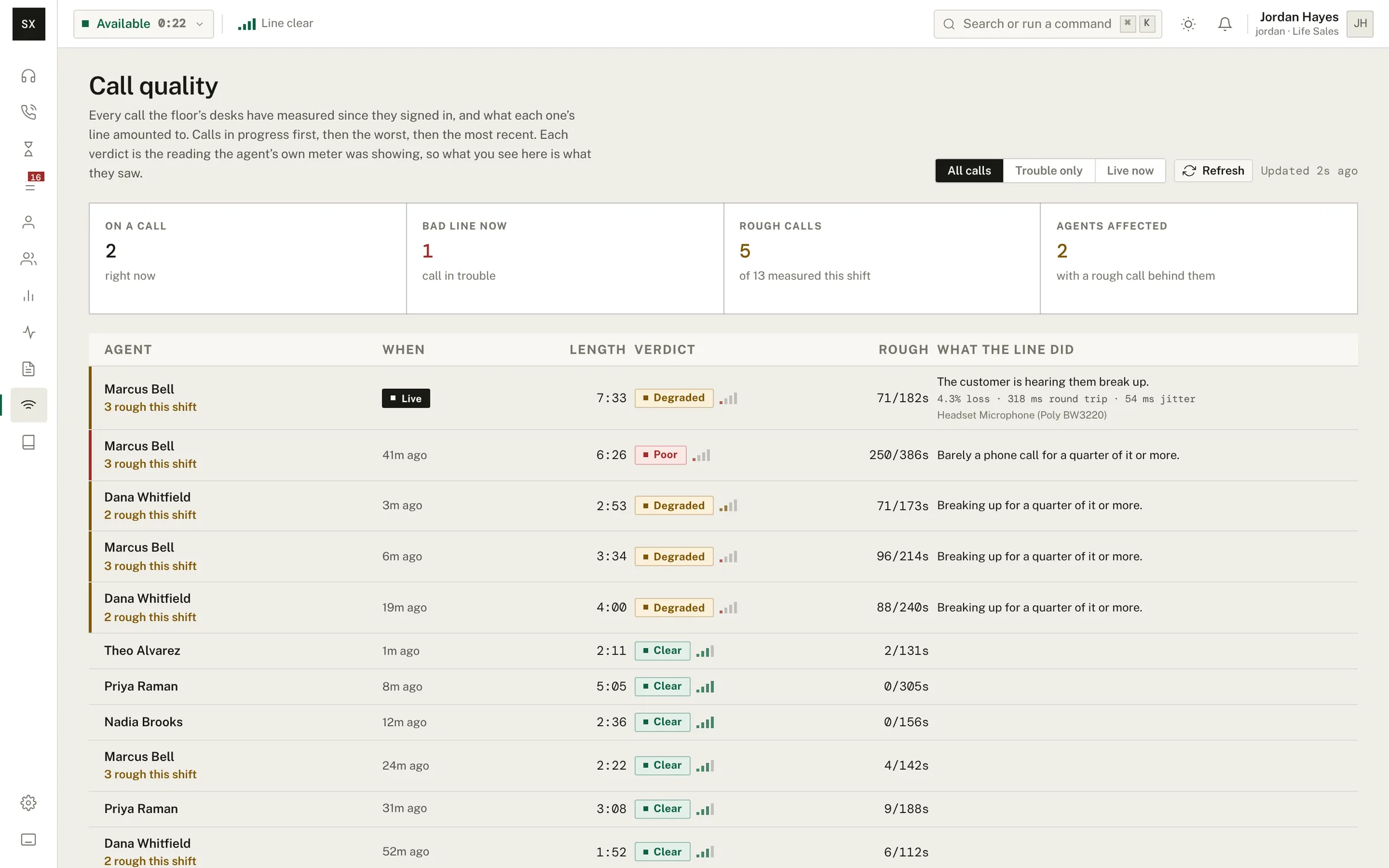
The line, while the call is still up
Packet loss, round trip and jitter on both legs of every call, with a plain verdict: clear, rough, degraded, poor.
The desks that are not reporting are listed too, so silence is never read as a clean line.
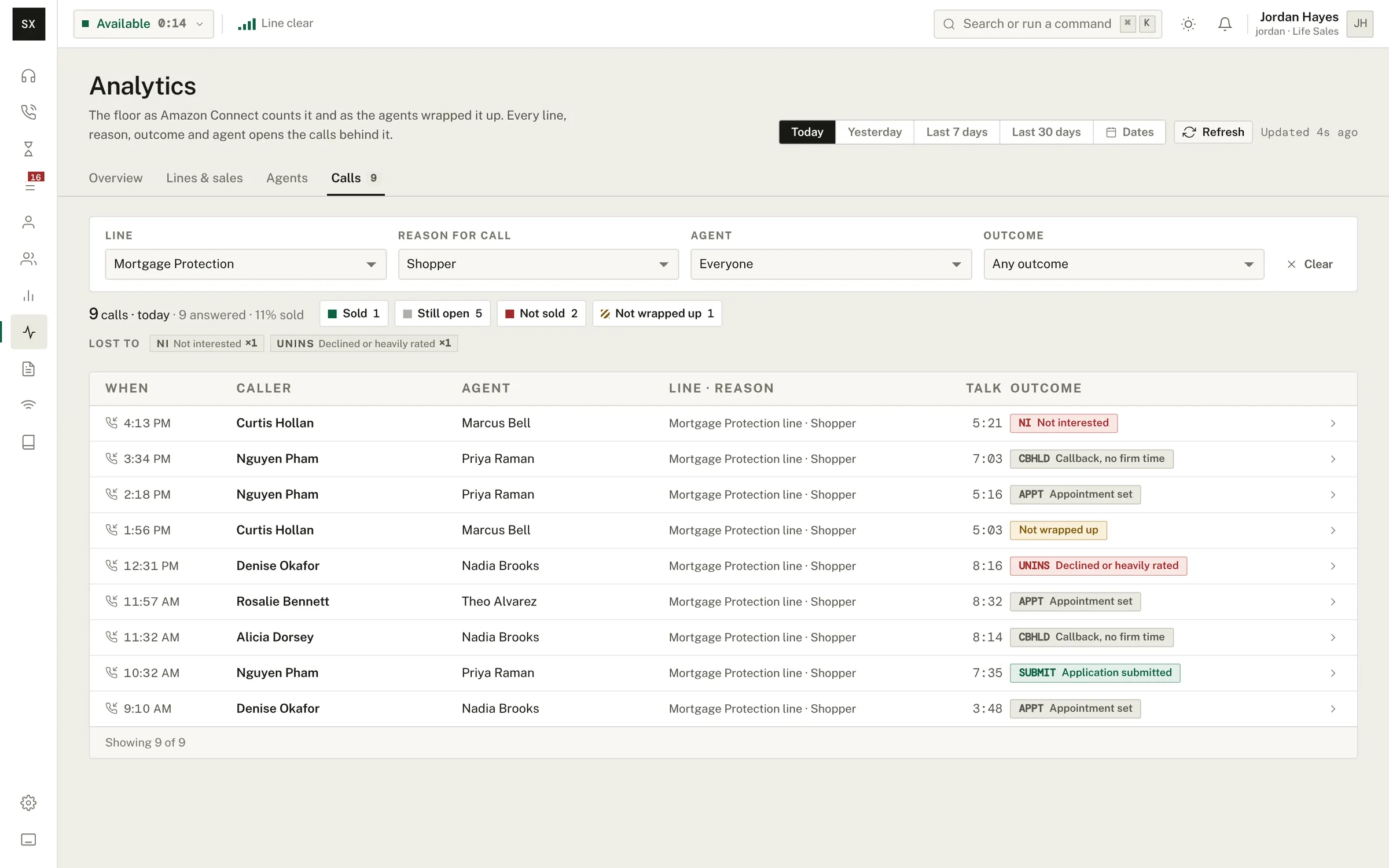
The floor's numbers, and the calls behind them
Amazon Connect's own counts for the floor, joined with what the desk alone knows: which line they rang, why they called, and how it was wrapped up.
Shown here: today's Shopper calls on the Mortgage Protection line, and what each one turned into.
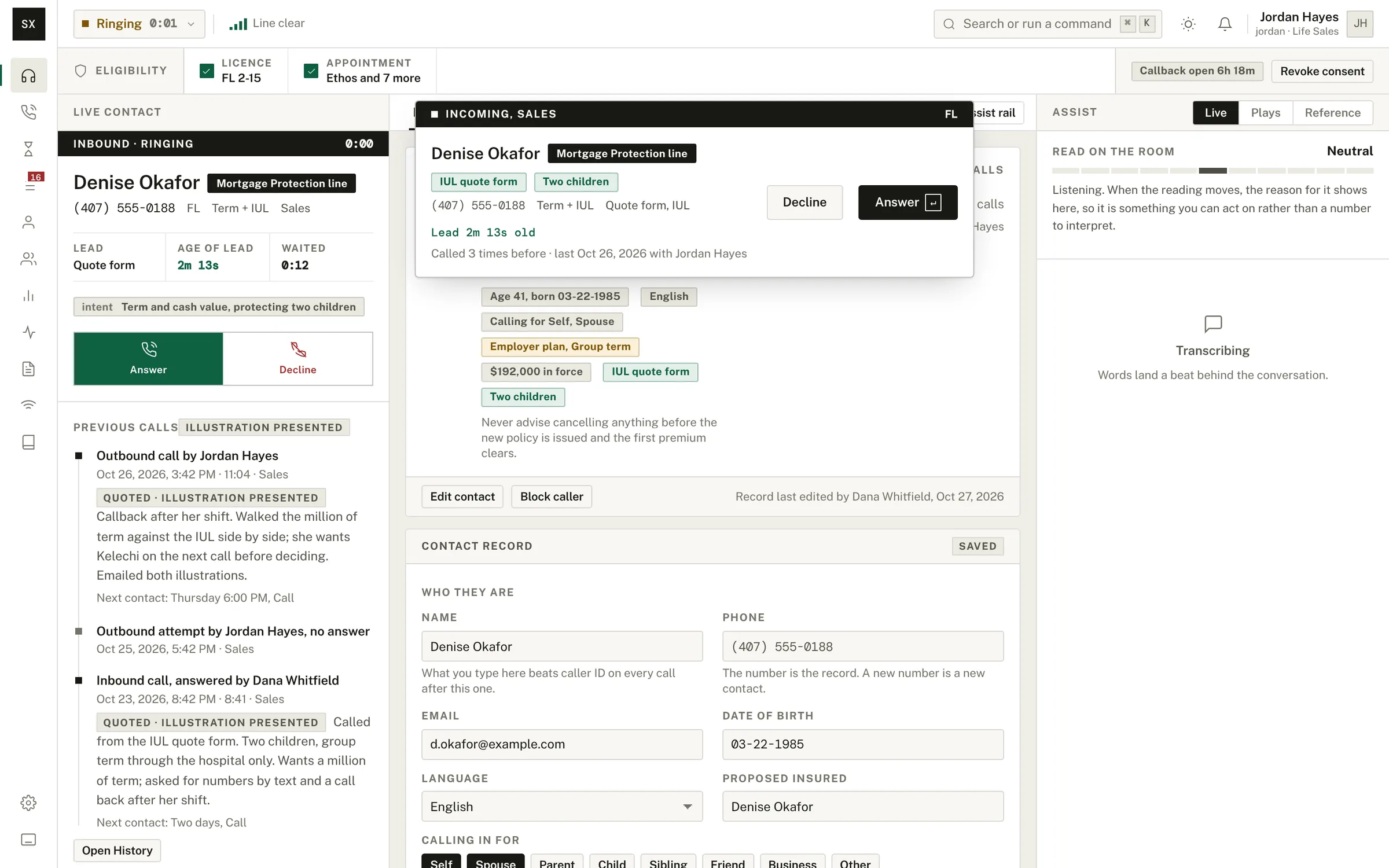
The lead, before the first ring ends
Who is calling, which line they dialed, how many minutes old their quote form is, and what they asked for on it: term and cash value, protecting two children.
The agent answers already knowing the pitch.
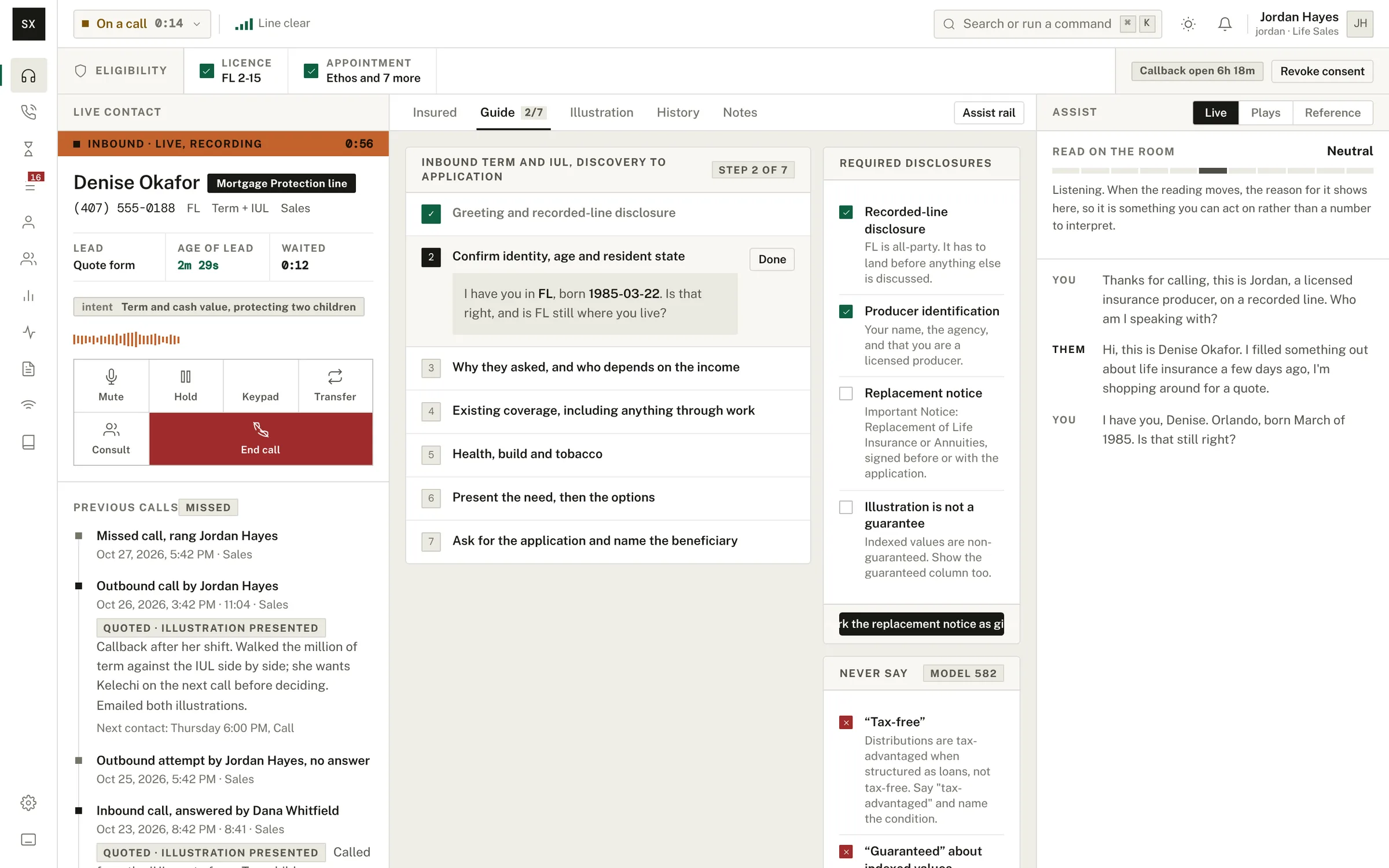
The script, with the disclosures it owes
Seven steps, in order, beside the disclosures the state and product require and the phrases a producer must never say about an indexed product.
Amazon Connect keeps the phones. We own the screen.
There is no telephony migration. The customer's Connect instance keeps routing, recording and carrying the audio, through Amazon's own control panel running hidden inside our page. Everything the agent sees and touches is SwitchCX.
- The callerAny phoneDials one of the agency's numbers.
- PSTN
- Customer's AWS accountAmazon ConnectNumbers, routing, queues, recording, Contact Lens. Unchanged.
- Audio
- Agent's browser · ChromeSwitchCX deskEligibility, transcript, wrap-up, queue, leads, analytics. A static page, no server to fall over.Amazon Connect control panel, hidden inside the page: sign-in, WebSocket, WebRTC audio.
- HTTPS
- Same account · deployed by CISwitchCX APILambda and DynamoDB. Transcript relay, floor reads, wrap-up write-back, grading.
- Writes to
- SalesforceA Task on the lead, per callClaude Haiku 4.5Summary and script grading
Nothing to migrate
No numbers to port and no carrier change. Add our origin to Connect's approved list, sign agents in with the passwords they already have, and the floor is on.
Nothing about the caller in a log
Phone numbers, contact attributes and transcripts are never logged and never go to third-party analytics. Transcripts expire on a timer, with no backup that outlives it.
Rehearsed before it is real
Every screen state, including the failures (microphone denied, a second tab, a network drop mid-call), runs in a simulator on every preview build.
The gates and the rater, fed from the source.
Every stub below already has its place in the desk and a working call signature waiting for an endpoint.
Live licence and appointment feeds
NIPR licensing and carrier appointment data behind the eligibility band, replacing the agency's own list.
Live carrier rates in the quote
A comparative rater behind the illustration workspace, so the number on screen is the number on the application.
Household and beneficiary on screen
Amazon Connect Customer Profiles read into the Insured tab, under the record the floor already keeps.
The next floor
The desk is configured, not forked: instance, lines, carriers, scripts and outcome codes each live in one file.
See it take a real call.
We will walk you through the desk on the production line: a call ringing in, read while it happens, wrapped up, and graded a minute later.